

Service
Website design for businesses, with a search-engine-optimised structure from the start
We build websites for companies that want their website to bring in new clients, whether they sell to businesses or to private individuals. As a Budapest-based company, we work nationwide. We build the site on a search-engine-optimised structure from the outset: before the design stage, we decide which subpage answers which search, so that Google understands what you offer from day one. A simple brochure website will be ready for you to view 3–4 weeks after the first consultation, and the cost of hosting and the domain for the first year is included in the price.

Google Ads Partner certification
01
What do you get when we build your website?
The work runs from clarifying your goals through to a live site that Google can also read easily. It includes:
- a joint consultation on what the site is for and who it needs to reach;
- keyword research to find out which words your prospective clients use when searching;
- a site plan showing which subpages will be created and how they link to each other;
- the design and structure according to the option you choose: as a brochure website, a WordPress website or a webshop;
- a responsive (mobile-friendly) design, so that the site is easy to use on both phones and computers;
- the technical foundations for search engines: page titles, meta descriptions, descriptive URLs, well-organised headings and internal links;
- hosting and the domain for the first year.
We don't hand over an ‘off-the-shelf’ product. The structure is shaped around your services and your customers' searches, which is why we create a separate site plan for every company.
Copywriting is charged separately. You can supply the copy yourself, or we can write it so that it works for both readers and search engines. After go-live, the substantial part of the work continues for months: new content, link building (backlinks) and rank tracking. We cover this in detail on our search engine optimisation page.
02
Why do we start by planning the structure?
Google understands what a website is about from its structure. It looks at which subpages exist, what their titles and headings say, and how they link to each other. If all your services are lined up on a single ‘Our services’ page, the search engine can't decide which search to show it for, and it will most likely not move up for any of them. But if every important service gets its own subpage with its own title and text, each one can compete separately for an organic result.
This has to be decided before the design. If we change the structure of a finished site afterwards, the URLs change, redirects have to be set up, the texts have to be split up and rewritten, and the rankings you have already earned may slip in the meantime. That's why we don't patch the site up afterwards: we build it from the outset with a structure that Google can easily interpret. Only then do we design the look, on the framework that is already in place.
Besides keyword research, we also use advertising data to see which subpages are needed. We hold Google Ads Partner certification, so if your company already runs a campaign, we look at which searches people click on and request quotes from. If a term regularly brings in enquiries, it is worth targeting with its own subpage.
03
Questions we answer before planning
In our first conversations, clients regularly raise the same questions, and these are exactly what determine whether the website will work. That's why we go through them together before planning.
The first is the goal. What should your website achieve in your case: phone calls, quote requests via a form, online orders, or reassuring a prospective partner of your company's reliability before a meeting? The goal determines what goes on the first screen of the home page and where the phone number or the quote request button appears.
The second is the target audience. A buyer at a manufacturing company looks for detailed technical data on an office computer. Someone looking for a professional for an urgent repair browses on their phone and wants to see quickly who they can call. The same structure won't suit both, so we clarify who your main customer is and who is secondary.
The third is which questions the site needs to answer. Prospects usually want to know exactly what you offer, to whom, in which area, roughly how much it costs and how long it takes, and how working together begins. Anything the site doesn't answer, visitors will either ask about by phone or look for on a competitor's site instead. These answers form the list of subpages and the outline of the copy.
04
What makes a website work – and why doesn't your current one?
We are often asked what makes a good website and what it takes. Our yardstick is whether it brings in new clients. For that, three conditions must be met: prospective clients find it on Google, once on the site they quickly understand that they are in the right place, and they can easily take the next step. Don't settle for simply having a website, because if any of the three is missing, the site serves as little more than a business card.
If your current site isn't generating enquiries, the problem usually lies in one of these three points.
- / 01
They don't find it
The site doesn't appear for the terms your customers type in. Perhaps the services don't have their own subpages, or the copy doesn't use the words people search with. It also happens that Google hasn't even included some pages in its index.
- / 02
They find it, but move on
The visitor arrives, then goes back after a few seconds. In such cases, the page often loads slowly, falls apart on mobile, or the first screen doesn't make clear what the company does and where.
- / 03
They stay, but don't get in touch
The prospect reads the text but can't find a phone number, the form asks for too much information, or it isn't clear what to do next.
Before we plan a new site, we use the data from your existing site to see which of these is the problem in your case, so that the new site fixes the real issue.
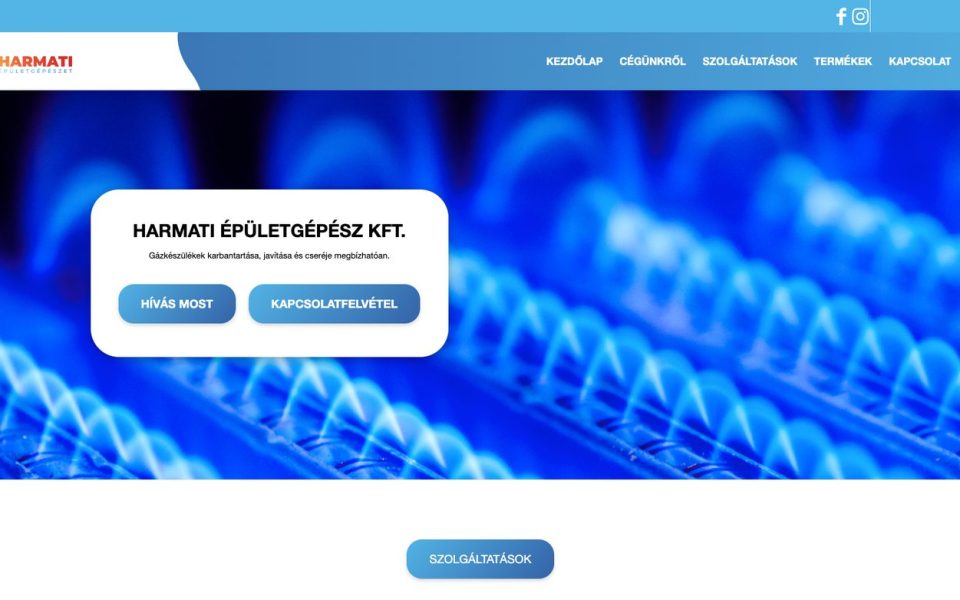
05
Brochure website, WordPress website or webshop
Which option suits you depends on how much content you need to display, who will edit the site, and whether you also sell directly online.
| Option | Who it's for | What to consider when deciding |
|---|---|---|
| Brochure website | A few clearly defined services, little changing content | Every main service should get its own subpage, even if there are only a few |
| Expandable WordPress website | Many services, regularly updated content, a blog | Who uploads new content and how often, whether you need several languages |
| Webshop | Online ordering and payment | How many products there are, what categories they fall into, whether the descriptions and images are ready |
People often choose a WordPress website because you can edit the content yourself later, and the site can be extended with new subpages without having to be rebuilt. In webshop development, the category structure matters just as much as it does for service pages: the names of the categories and product pages are aligned with the terms shoppers search for. If you can't decide which option you need, we will make a recommendation after the first consultation.
06
What do the price and the timeframe depend on?
The cost of website design depends mainly on the size of the site and the features required. In the quote, we take the following into account:
- how many subpages are created and how complex the structure is;
- whether any special features are needed, such as a booking calendar, a calculator or multiple languages;
- for a webshop, the number of products and the payment and delivery options;
- whether you would like us to write the copy.
The first year of hosting and the domain is included in the price, but copywriting is charged separately. It's worth deciding on this at the start, because the copy and the structure are linked: a search-engine-optimised subpage needs copy built around the terms assigned to it.
For a simple website, 3–4 weeks pass from the first consultation until you can view the finished site. For a webshop, the timeframe depends on how quickly we receive the product data: the names, descriptions, prices and images. A webshop can't go live with an incomplete product list, so it's worth putting this together at the very start of the project.
07
The process from first enquiry to launch
We build your website in five stages:
- Step
Consultation on goals and target audience
We go through the pre-planning questions and, if you already have a site, look at why it isn't bringing in enough enquiries.
- Step
Keyword research and site plan
We collect what your customers search for and assign the subpages to those search terms. Where advertising data is available, we take that into account too.
- Step
Design
The look is created for the approved structure, for both mobile and desktop.
- Step
Build and content
We build the site, upload the copy and images, and set up the page titles, meta descriptions and internal links.
- Step
Review and launch
You review the finished site, we make any corrections you ask for, then we put it live and submit the XML sitemap to Google so that it crawls the site as soon as possible.
08
Website design with us, in brief
- / 01
We plan the structure based on searches, before the design.
- / 02
The price includes the first year of hosting and the domain; copywriting is charged separately.
- / 03
A simple site is ready in 3–4 weeks; for a webshop, the pace is set by when the product data arrives.
- / 04
We take on work nationwide and always start by clarifying your goals and target audience.
Can website design be done without a professional?
With a template-based site builder you can quickly put together a working site, and for a start-up this may be fine for a while. What is typically left out in such cases is a search-based structure, the technical settings and tracking. If you expect new clients from Google, their absence soon shows.
Should I provide the copy, or will you write it?
Both work. If you write it, we will tell you, based on the site plan, what topic each subpage needs copy on. If you leave it to us, we will write it for an additional fee.
What happens with the hosting and domain after the first year?
In the first year, the cost of both is included in the website design price. After that, this item is no longer part of the build price; we discuss it at the first consultation.
Where can I see completed work?
We showcase the results of some of our clients in our website portfolio.
When will the new site appear on Google?
After launch, we submit the sitemap to Google, but it is Google that decides when the pages appear in the search results and when they achieve good rankings. This depends on the competition, the targeted terms and the amount of content, so nobody can promise an exact date. You can track progress using Search Console data.
Services
Our other services
Next step
Where does the work start in your situation?
“Professional team, reasonable prices. A high level of expertise :)”
- / 01
If you have a working site that isn't generating enquiries, we start with your current site's data and look at whether the problem lies in being found, being understood or getting people to get in touch. This also shows what can be kept on the new site.
- / 02
If you're planning a webshop, prepare the product list with descriptions, prices and images, because we design the category structure based on it.
- / 03
If you don't have a website yet, the first step is a consultation about your goals and target audience. In your message, we first look at what you offer, to whom, and whether you already have a domain, so please include these three things in the message you send via the contact page.